

Tisza’s Plan for a Functioning and Humane Hungary
Gabriela Greilinger discusses the most important points of the Tisza Party’s newly released party programme, which lays out its plan for a “functioning and humane Hungary”.


“The Orbán government has stolen our future”
In 62 days, Hungary stands at a crossroads, facing two choices: either re-elect the Fidesz government, in power for 16 years, during which corruption has soared, and democracy has been transformed into electoral autocracy; or elect a new government led by the rising opposition party, Tisza, under the leadership of Péter Magyar, a former Fidesz member, who vows to eradicate corruption and bring Hungary back into the fold of European democracies.
Last weekend, Tisza published and presented its 240-page-long programme for a “functioning and humane Hungary”, created by people and prepared over one and a half years in consultation with over a thousand experts and professional organisations.
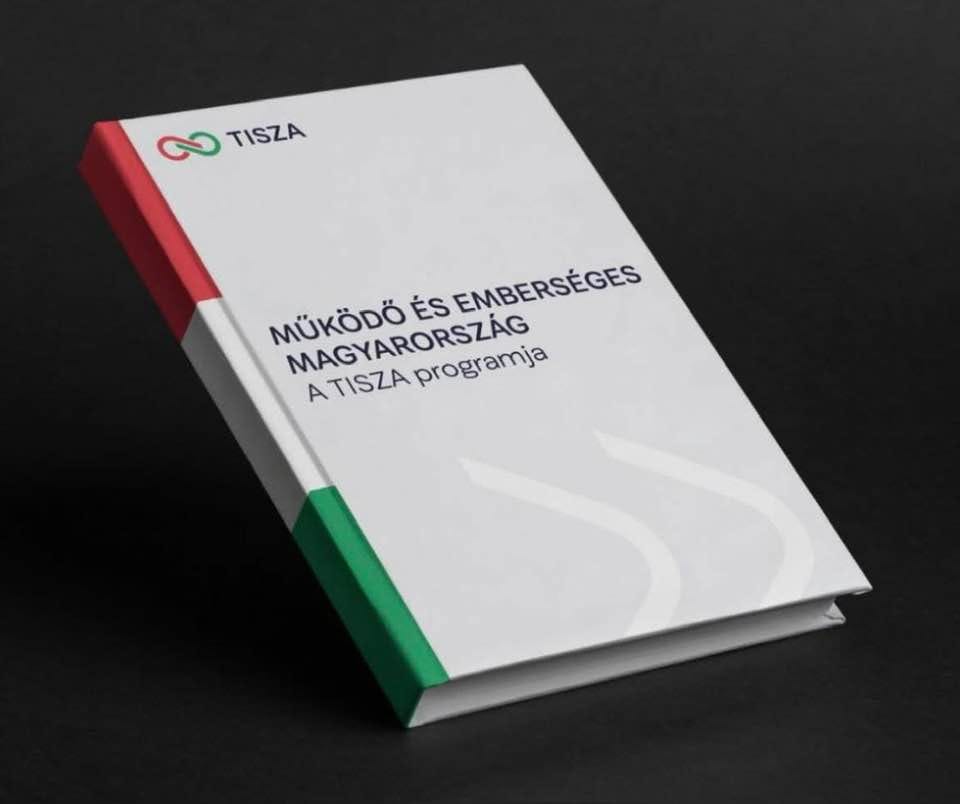
Across four main chapters, dealing with economic development and growth, security and stability, societal welfare and wellbeing, and sustainability and “future proofing”, Tisza lays out its vision for Hungary under its leadership.
Economy, healthcare, and welfare: “A government that serves, not rules”
One of Tisza’s frequently-stated core goals is to eliminate corruption and, as a result, improve the living standards of ordinary Hungarians and the quality of Hungarian public services. To that end, their programme offers a comprehensive plan for achieving these goals.
Even though Fidesz has warned that Tisza’s economic plan would raise taxes and burden families, Tisza has vowed not to raise taxes on the wages of ordinary Hungarians and actually seeks to reduce the tax burden on the poorest. The flat personal income tax of 15 per cent, introduced by the Orbán government, has previously been criticised by experts as it primarily benefits higher-income earners while disadvantaging the poor, who are subject to the same tax rates as the richest Hungarians. Tisza thus seeks to reduce the income tax on minimum wage from 15 per cent to 9 per cent, thereby alleviating financial burdens on the poorest households. To further alleviate societal inequalities, Tisza also seeks to introduce a 1% wealth tax on assets worth more than 1 billion forint (approximately 2.6 million Euros).
The rundown state of the healthcare services across the country presents another crucial pain point, which Péter Magyar drew attention to in the summer of 2024. To improve the system, Tisza aims to address shortages of specialist doctors and nurses through targeted scholarships and higher salaries, while also expanding capacity and introducing intelligent patient management to reduce waiting times.
In terms of family policies, also central to Orbán’s politics, Tisza’s social policy expert asserts that “the state must stand by the families, in every life situation”. Hence, they’re planning to double the family allowance and the maternity support. Moreover, they plan to increase the allowance for single-child families, single parents and families raising children with disabilities. In addition, they aim to elevate fathers’ roles in families by, for example, guaranteeing paternity leave. This is a significant deviation from Fidesz’s stance, which primarily elevates traditional, heteronormative family models (one father, one mother) and has established a “carefare” regime over the years.
As for pension payments, Tisza promises to keep the recently rolled out 13th- and 14th-month pensions, two extra payments per year equivalent to a monthly pension compensation. The matter has been increasingly politicised by Fidesz, who claimed that “Brussels” and opposition-aligned economists want to get rid of these extra pensions and that no other EU member states have such a thing (a lie, because neighbouring Austria and a range of other EU countries have 13th and 14th months pensions and salaries).
In addition, Tisza vows to establish a standalone ministry of education, which does not currently exist in Hungary, as the issue of education has been subsumed under other ministries over the years.
Finally, they also commit to investigating child abuse committed over the past decades and promise compensation. This is a particularly critical point given the child abuse scandals that have emerged in recent years, the pardon scandal related to a child sexual abuse case that prompted the resignation of former president Novák and justice minister Varga (Magyar’s ex-wife), and the government’s inaction on the dire state of state-run child protection services.
Corruption and the rule of law
Tisza declares zero tolerance for any kind of corruption in its programme. More specifically, they seek to establish a “National Asset Recovery and Protection Office” to investigate corruption cases and economic and political mismanagement over the past two decades. As such, they promise to hold the powerful accountable, with potential consequences for Fidesz politicians. Moreover, they want to join the European Public Prosecutor’s Office, an independent EU body that investigates and prosecutes fraud, corruption, money laundering, misappropriation of EU funds and related crimes, and which Hungary has yet to join.
Tisza further plans to restore the systems of checks and balances, guaranteeing the lawful functioning of the state. The return and strengthening of the rule of law is crucial, as Tisza seeks to bring home EU funds, which have been tied to respect for the rule of law and have consequently been suspended under the Orbán regime.
Interestingly, they also want to grant the Ministers of Education, Health, Justice, and Finance veto rights in the government’s decision-making process, possibly to ensure expertise-based governance in these subject areas.
Finally, and perhaps most consequentially, they seek to introduce a term limit for the prime minister, to prevent any future prime minister from ruling for decades, as Orbán did.
Relations with the EU and the world
Central to financing their economic programme and realising their ambitions for economic growth and development is the restoration of EU funds, which have been suspended by the EU due to the Fidesz government’s systemic corruption and rule-of-law concerns. As Tisza seeks to address these issues and normalise relationships with the EU, one of its core campaign promises and governing objectives is to recover these funds.
In addition to restoring relations with the EU, Tisza moreover seeks to rebuild ties with other key partners, notably the Visegrád Four (Czechia, Hungary, Poland, and Slovakia) and NATO. Overall, their aim is to become a “useful, credible, respected, active, and constructive member” of the EU and NATO. To enhance Hungary’s security, the party further pledges to raise its NATO defence spending to the required 5 per cent by 2035. They link this goal to the increasingly volatile international situation and state that the current government has greatly undermined Hungarians’ security by “exposing Hungary and its partners to Russian and other foreign interests”, hinting at Fidesz’s image of being a Trojan Horse for Russia and China.
Tisza, moreover, identifies Hungary’s energy reliance on Russia as a critical vulnerability. Thus, in line with its aim of reintegrating into Western international institutions and restoring relations, the party plans to become independent of Russian energy by 2035, a clear departure from Orbán’s policy, which has continuously deepened Hungary’s dependence on Russia, even after the (re-)invasion of Ukraine.
Similarities with Fidesz
Despite clear differences between Tisza’s and Fidesz’s politics, there are notable similarities in their policy positions on several issues, particularly war, Ukraine’s accession to the EU, the rights of Hungarian minorities abroad, and immigration.
Regarding conflict, Tisza claims to “stand on the side of peace and reject war and all forms of violence”, a position that echoes the current government’s stance, which, already in 2022, campaigned heavily on “peace” and stoked fears that Hungary would be dragged into the war by the EU if Fidesz was not re-elected – a position they now also double down on. Relatedly, Tisza pledges not to send Hungarian soldiers to the war, which likewise aligns with Fidesz’s position. Moreover, they do not support Ukraine’s accelerated accession to the European Union, an issue that Orbán has similarly repeatedly raised too.
On Hungarian minorities abroad, another sensitive subject, Tisza’s stance resembles Fidesz’s as both emphasise and seek to ensure that neighbouring countries guarantee their linguistic and cultural rights. As Hungarian minorities abroad are eligible to vote in the election (and have traditionally sided with Orbán), this is a crucial demographic to mobilise for both parties.
Finally, and perhaps most crucially, in light of Tisza’s aims to restore relations with the EU, the party vows to reject the migrant pact and migrant quotas. This is once again in line with Fidesz’s hardline anti-immigration position, which has likewise strained relations with the EU. Tisza’s equally anti-immigrant position is overall rather unsurprising, for three reasons: first, the party’s origins in the right-wing camp, with Péter Magyar being a former Fidesz politician himself; second, the fact that progressive positions on immigration are generally not very popular after 16 years of anti-immigrant propaganda by Orbán; and third and related, because deviating significantly from the current government’s stance on the issue would enable Fidesz to portray Tisza negatively and stoke hysteria about them allowing Hungary to be overrun by immigrants and asylum seekers (however unlikely that scenario might be).
What’s next for Hungary?
Amid a cost-of-living crisis, declining quality of public services, and rising political dissatisfaction, polls increasingly indicate a potential Tisza victory. Tisza’s electoral programme clearly seeks to address these issues while not straying too far from the typical Fidesz voter’s attitudes, for example, on immigration and Russia’s war in Ukraine.
Yet, despite mostly favourable polls, a Tisza victory and a change in government are far from certain as Orbán has tilted the media and electoral playing field over the years. Moreover, even if Tisza wins, without a clear two-thirds majority, it will have difficulty making any meaningful changes in the country.
Meanwhile, Orbán and his allies seem to gear up towards a “big lie”: Balázs Orbán, Viktor Orbán’s political director (no relation), recently shared a post by the GOP House Committee on the Judiciary, on X (formerly Twitter), alleging that the European Union interferes in elections across Europe to bring about desired results. In a long post, Balázs Orbán claimed that the “Brussels elite” is seeking a change of government in Budapest and suggested that the “digital censorship” pushed by the European Union could be a means of doing so in Hungary. As such, Fidesz seems to be preparing to claim election interference if it loses in April. And it is possible that it would seek backing for such claims from the Trump administration, which has made similar allegations after losing the 2020 election. Given America’s role as a global leader, the administration’s support for such allegations would not only lend them legitimacy but also sow distrust in the democratic process and further polarise Hungarian society.
The stakes of this election are high: On April 12, Hungary could finally see a change of government and significantly influence European and international politics by voting a key figure in the illiberal alliance out of office. However, domestically, it remains to be seen whether Magyar would only find himself “in office”, without a sufficient mandate to implement his planned reforms, or also “in power”, able to bring about the “regime change” he envisions.
Gabriela Greilinger
 | A guest post by
|
A very good and balanced summary of the present situation in Hungary, just two months before the elections. The sensible majority feels that Orbán's regime must go. At the same time, the fear, that fraud may keep them in power is also high. Sixteen years in power is easily project them invincible. Many of the brightest legal minds suggest, that the whole system is so much rotten, that a truly independent judiciary can blow fresh air, the criminal acts can be punished and Hungary will get back to real democracy.
These brilliant and original ideas presented by Tisza are nothing new and have been tried in most Western democracies with limited success. Perhaps the article should be retitled 'We are willing to sacrifice everything to oust Fidesz, no matter the cost to the Hungarian people'. You don't have to look far to see what happens when you elect a party that is not capable of running the government, despite campaigning on the promise of a functioning and humane government. Welcome to the liberal left in the UK.